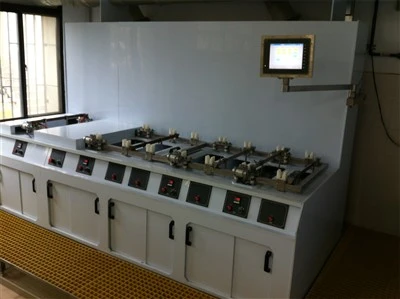
As a leading provider of surface treatment equipment, I've witnessed firsthand the transformative journey of this industry. Surface treatment is a critical process in various manufacturing sectors, enhancing the durability, appearance, and functionality of products. In this blog, I'll explore the future trends of surface treatment equipment development, which are set to redefine the way we approach surface finishing.
Automation and Industry 4.0 Integration
One of the most prominent trends in surface treatment equipment development is the integration of automation and Industry 4.0 technologies. Automation streamlines the surface treatment process, reducing human error, and increasing efficiency. With robotic arms and conveyor systems, the movement of workpieces between different treatment stations can be precisely controlled, ensuring consistent quality throughout the production line.
Industry 4.0 takes automation a step further by enabling the interconnectivity of machines, data collection, and analysis. Smart sensors can monitor key process parameters such as temperature, pressure, and chemical concentrations in real - time. This data is then transmitted to a central control system, where it can be analyzed to optimize the treatment process. For example, if the sensors detect a deviation in chemical concentration, the system can automatically adjust the dosing to maintain the desired levels.
At our company, we are at the forefront of integrating these technologies into our products. We offer surface treatment equipment that can be easily connected to a factory's IoT network, providing manufacturers with real - time insights into their processes. This helps in reducing downtime, improving product quality, and increasing overall productivity.


Environmentally Friendly Solutions
In an era of growing environmental awareness, the demand for environmentally friendly surface treatment solutions is on the rise. Traditional surface treatment processes often involve the use of hazardous chemicals, which can have a negative impact on the environment and human health. Future surface treatment equipment will focus on developing and implementing more sustainable alternatives.
One such trend is the use of water - based coatings and plating solutions. Water - based coatings have lower volatile organic compound (VOC) emissions compared to their solvent - based counterparts, making them a more environmentally friendly option. Additionally, advancements in electroless plating technology are reducing the dependence on harmful heavy metals. For instance, our El Ni - Pd - Au Equipment uses environmentally friendly plating solutions that minimize the use of toxic substances.
Another aspect of environmental sustainability is the recycling and reuse of treatment chemicals. Modern surface treatment equipment is being designed with built - in chemical recovery systems. These systems can separate and purify used chemicals, allowing them to be reused in the treatment process. This not only reduces waste but also lowers the overall cost of production.
Precision and Customization
As the manufacturing industry becomes more specialized, there is a growing need for surface treatment equipment that can provide high - precision and customized solutions. Different products have different surface treatment requirements, and equipment needs to be flexible enough to meet these diverse demands.
Advanced coating and plating technologies are being developed to achieve greater precision in layer thickness, surface roughness, and composition. For example, our Electroless Copper Plating Equipment can deposit copper layers with extremely precise thicknesses, which is crucial for applications in the electronics industry.
Customization also extends to the ability to create unique surface finishes. Manufacturers can now achieve a wide range of textures, colors, and patterns on the surface of their products, enhancing their aesthetic appeal. Our surface treatment equipment can be programmed to create custom - designed surface finishes based on the specific requirements of the customer.
Miniaturization and Micro - surface Treatment
With the continuous development of the electronics and medical device industries, the demand for miniaturized products is increasing. This has led to the need for surface treatment equipment that can perform precise treatment on micro - scale components.
Micro - surface treatment involves treating surfaces with extremely small dimensions, often in the micrometer or nanometer range. Specialized equipment, such as micro - electropolishing machines, is required to achieve the desired surface quality on these tiny components. Our Electropolishing Equipment is designed to handle micro - scale workpieces, providing a smooth and uniform surface finish.
Miniaturization also presents challenges in terms of handling and positioning of the components. Future surface treatment equipment will need to incorporate advanced micro - handling technologies, such as micro - robotic arms and precision positioning systems, to ensure accurate treatment of these small parts.
High - speed and Continuous Processing
In today's competitive manufacturing landscape, speed and efficiency are of utmost importance. Surface treatment equipment is being developed to handle high - volume production with continuous processing capabilities.
High - speed coating and plating technologies are emerging to reduce the treatment time per workpiece. For example, new electroplating techniques can deposit metal layers at a much faster rate without compromising on quality. Our Stannatech Equipment is designed for high - speed tin plating, enabling manufacturers to increase their production output significantly.
Continuous processing systems are also becoming more prevalent. These systems allow workpieces to pass through different treatment stations without interruption, eliminating the need for manual handling between processes. This not only speeds up the production but also reduces the risk of contamination and damage to the workpieces.
Advanced Materials and Coating Technologies
The development of new materials and coating technologies is another key trend in surface treatment equipment. As new materials are introduced in various industries, the surface treatment requirements for these materials also change.
For example, the use of composite materials in the aerospace and automotive industries requires specialized surface treatment to improve their adhesion, corrosion resistance, and wear resistance. Our Electroless Nickel - Gold Plating Equipment can be used to apply high - quality nickel - gold coatings on composite materials, enhancing their performance.
In addition, nanocoatings are gaining popularity due to their unique properties, such as high hardness, self - cleaning, and anti - microbial characteristics. Future surface treatment equipment will need to be capable of applying these advanced nanocoatings with high precision.
Conclusion
The future of surface treatment equipment development is full of promise, with a focus on automation, environmental sustainability, precision, miniaturization, high - speed processing, and advanced materials. As a surface treatment equipment supplier, we are committed to staying ahead of these trends and providing our customers with the most innovative and reliable equipment solutions.
If you are in the market for surface treatment equipment and want to discuss how our products can meet your specific needs, feel free to contact us. Our team of experts is ready to assist you in finding the best solution for your manufacturing processes.
References
- Smith, J. (2020). "Advancements in Surface Treatment Technologies." Journal of Manufacturing Science.
- Johnson, A. (2019). "Automation in Surface Treatment Equipment." Global Manufacturing Review.
- Brown, C. (2021). "Environmental Considerations in Surface Treatment." Sustainable Manufacturing Journal.